The History of Roulette

Roulette has been around for more than 300 years and remains one of the most popular casino games today. What started as a simple wheel game in France is now played in land-based casinos and online platforms worldwide. Our team looks at how roulette developed over time and why it continues to attract players across different markets and technologies.
The Origin of Roulette
Roulette dates back to 1655 and is linked to the French mathematician Blaise Pascal. He was trying to create a perpetual motion machine, but instead designed a spinning wheel with numbered sections. While the experiment failed, the wheel itself worked perfectly for games based on chance. It relied on balance, randomness, and probability, which are still the core mechanics of roulette today.
The first written record of roulette appeared in Paris in 1796 in the novel La Roulette, ou le Jour. The game was played at the Palais Royal and included both single- and double-zero pockets. Roulette was influenced by earlier gambling games like Roly-Poly, Even-Odd, and Ace of Hearts. French high society quickly adopted it, especially in private gambling salons. The name “roulette” comes from the French term for “little wheel,” which accurately describes the game.
Roulette also became known as “The Devil’s Game” because the numbers 1 to 36 add up to 666. This led to myths and stories, including one claiming casino operator François Blanc made a deal with the devil. While these stories aren’t true, they helped make the game more intriguing and memorable.
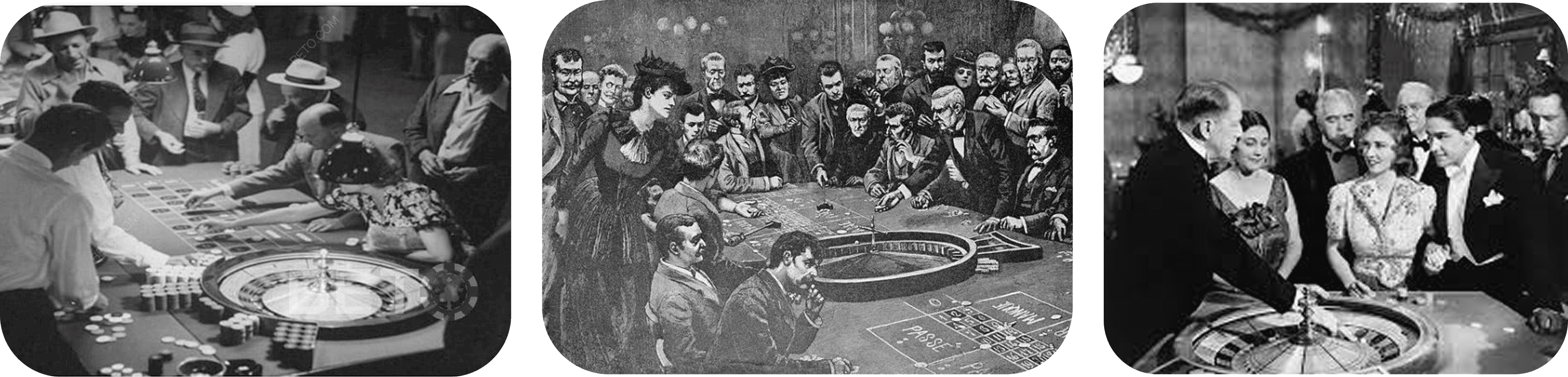
Timeline of Roulette’s Evolution
Our team has outlined the key moments that shaped roulette into the game players know today:
- 1655 – Blaise Pascal creates the early roulette-style wheel in France
- 1796 – First written mention of roulette appears in Paris
- Early 1800s – Roulette becomes popular in French gambling houses
- 1843 – François and Louis Blanc introduce the single-zero wheel in Germany, reducing the house edge
- 1863 – Monte Carlo Casino opens with the single-zero wheel
- Mid-1800s – Roulette spreads to the United States and adopts the double-zero wheel
- 1873 – Monte Carlo becomes the world’s most famous roulette destination
- 1970s–1980s – Roulette becomes standard in Las Vegas and Atlantic City
- 1994–1996 – Online casinos launch digital roulette games
- 2003–2006 – Live dealer roulette is introduced
- 2010s – Mobile roulette grows with smartphone use
- 2020s – VR, crypto, and live roulette expand rapidly, boosted by COVID-19 lockdowns
Modern Days of Roulette
Today, roulette is mainly played online, making it easier to access than ever before. Online roulette uses Random Number Generators (RNGs), allowing players to play at any time without waiting for others. Games run quickly, and minimum bets can be as low as $0.10, which is much lower than most physical casinos. Online platforms offer many versions, including European, American, speed roulette, multi-wheel games, and themed designs with added features like auto-play and saved bets. Live dealer roulette is also popular, streaming real wheels with professional dealers through HD video. Players can chat, watch every spin from multiple angles, and enjoy added features like multipliers. Mobile devices are now the main way players access roulette, with touch-friendly layouts designed for phones and tablets. New technology continues to shape the game, including virtual reality casinos, cryptocurrency-based roulette with provable fairness, and AI tools that suggest games based on player behavior.
Key Innovations That Shaped Roulette
The Single-Zero Wheel
Our team considers the single-zero wheel the most important change in roulette history. Introduced in 1843, it reduced the house edge by nearly half. This gave European casinos an advantage and explains why European roulette still offers better odds than the American version.
Electronic and Video Roulette
Electronic and stadium roulette allow many players to bet on one wheel using individual screens. These formats increase game speed and lower minimum bets. Video roulette also made it possible for smaller venues to offer roulette without dealers or full tables.